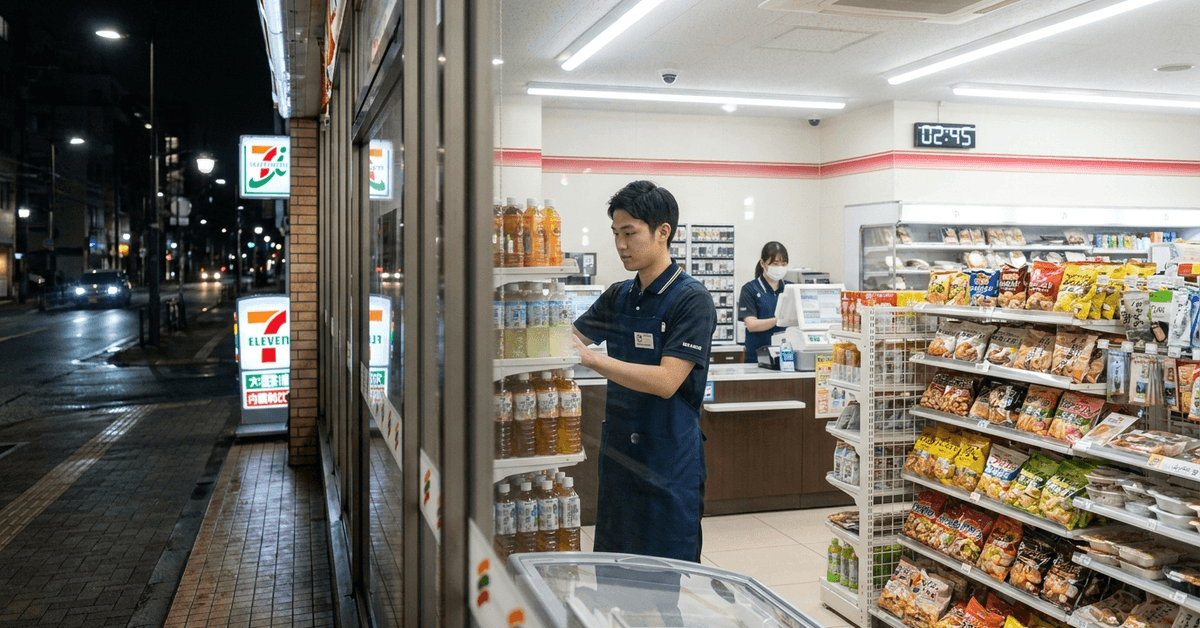
A 7-Eleven night shift job in Japan usually pays 20 to 30% more per hour than the same work at the same register in daylight. For an international student, that percentage decides almost everything.
Student visa holders get 28 work hours a week, counted across every job and any seven days in a row. Extra hours are off the table, so the hourly rate is the only lever left.
This guide is for international students weighing overnight konbini work against morning classes and visa renewal. Expect real yen figures and one popular tip worth throwing out.
How Much Does a 7-Eleven Night Shift Pay in Japan in 2026?
Night staff at 7-Eleven generally earn 20 to 30% above the daytime rate, and some locations add night bonuses or allowances on top of that.
Labor Standards Act Article 37 requires Japanese employers to pay at least 25% extra for any work done between 10 p.m. and 5 a.m.
I'd question any posting stuck at the low end of that 20 to 30% range, since 20% sits under the legal floor for 10 p.m. to 5 a.m. work. Ask the manager how the payslip calculates it.
The 5 a.m. to 6 a.m. Hour Pays Less
The usual 7-Eleven night shift runs from about 10 p.m. to 6 a.m., so its last hour falls outside the legal premium window.
Stores may pay that final hour at the regular rate. Check the written contract, called a koyō keiyakusho, for the exact split ahead of your first shift.
Minimum Wage Rose Again This Autumn
Japan's national weighted average minimum wage climbed to ¥1,177 an hour for fiscal 2026, according to the Japan Institute for Labour Policy and Training, with new rates rolling out between October 1 and December 2.
Tokyo moved to ¥1,280, which puts the legal night rate there at ¥1,600 for the 10 p.m. to 5 a.m. stretch. Stores often pay above minimum, so treat these as floors.
Can International Students Work Night Shifts on a Student Visa?
Yes, if you are at least 18 and your residence card shows work permission (shikakugai katsudō kyoka) stamped on the back. Japanese labor law bars anyone under 18 from night work.
Student visa holders in Japan may work up to 28 hours in any seven-day period during term, and up to 8 hours a day during official school vacations.
Those 28 hours cover every job combined. A second gig at a ramen shop eats into the same allowance as your 7-Eleven shifts.
The Seven-Day Count Rolls
The cap applies to any seven consecutive days, so a fixed Monday-to-Sunday calendar offers no protection at all.
A Friday, Saturday, Sunday, Monday run of night shifts can break the limit even when each calendar week looks fine on the schedule.
Three Night Shifts Is the Real Ceiling
Labor Standards Act Article 34 requires at least a 45-minute break for shifts over six hours, so a 10 p.m. to 6 a.m. shift usually means about 7 hours 15 minutes of paid work.
Three of those shifts add up to 21.75 hours. A fourth would push the total near 29, one hour past the legal line.
The leftover six hours or so suit one short evening shift, provided no other job is already using them.
Night vs Day Shifts at 7-Eleven: The Weekly Yen Gap
Working three night shifts instead of three day shifts adds about ¥6,000 a week at Tokyo's 2026 minimum wage, for the exact same 21.75 hours.
The comparison below assumes the 45-minute break falls inside the premium window and uses minimum-wage floors before tax.
| Three day shifts | Three night shifts (10 p.m. to 6 a.m.) | |
|---|---|---|
| Base hourly rate | ¥1,280 | ¥1,280 |
| Rate for 10 p.m. to 5 a.m. hours | Not applicable | ¥1,600 |
| Hours worked per week | 21.75 | 21.75 |
| Weekly pay before tax | ¥27,840 | ¥33,840 |
| Four-week total | ¥111,360 | ¥135,360 |
Over a four-week month, the night schedule pays roughly ¥24,000 more without adding a single hour to your visa count.
Is the Night Shift a Smart Fit for Students With Morning Classes?
For degree students with 9 a.m. lectures, usually no. The popular line that the 10 p.m. to 6 a.m. slot fits neatly around school falls apart on a normal Tuesday.
I'd skip term-time night shifts in that case, since a 6 a.m. finish leaves about three hours of sleep before class. Schools track attendance, and immigration can review it at renewal.
Ever tried writing kanji on three hours of sleep? The extra ¥2,000 per shift buys very little if your attendance rate starts sliding.
Who the Overnight Slot Does Suit
The night schedule tends to work better for these groups:
- Language school students in afternoon class sessions, who can sleep through the morning
- Anyone working during official long vacations, when the 8-hours-a-day rule replaces the weekly cap
- Dependent visa holders with no class schedule to protect
- Learners who want Japanese practice at a calmer pace with fewer customers
I think vacation months are when the 10 p.m. to 6 a.m. shift earns its keep, because the 8-hour daily rule lets you stack far more nights than term time allows.
Applying for a 7-Eleven Night Shift: Documents and Interview
Most applications go through the official 7-Eleven Japan website or directly to a store manager, often after spotting a hiring poster near the counter.
The 7-Eleven Japan recruitment portal lets applicants filter openings by night shift (yakan) and store location. Local word of mouth still fills plenty of slots too.
What to Bring to the First Meeting
Pack these for the first conversation with a manager:
- A rirekisho (Japanese-style resume) with a recent photo
- Your zairyu card, with the work permission visible on the back
- Visa details and, at some stores, proof of school enrollment
- A written note of every other job and its weekly hours
The last item protects you as much as the store. Employers who let a student exceed 28 hours risk a charge of promoting illegal employment, so honest disclosure covers both sides.
The Interview Takes Under 30 Minutes
Interviews are informal but structured. Expect questions about why you want late hours and how you would handle a customer complaint or a restock.
Some managers add a short Japanese or math check. I'd treat the under-30-minute chat as a scheduling negotiation, since a reply usually arrives within a few days.
What Do Night Staff Do at 7-Eleven After Midnight?
Night staff restock shelves, clean the store, empty trash bins, handle basic food prep, and run the register, usually with only one or two people on shift.
Many 7-Eleven stores in Japan also process parcel drop-offs and bill payments around the clock, so night staff handle those counters too.
Customers are fewer and sometimes tired or difficult. Stores post emergency numbers and incident steps, and training covers both, though confidence mostly comes from repetition.
Taxes, Health Insurance, and Staying Visa-Safe
Night shift pay in Japan faces the same income tax withholding as daytime wages, and some part-timers may need to file a yearly tax return depending on income and residence status.
National Health Insurance and pension payments may also apply to part-timers. Rules shift with residency and contract length, so ask your city office for its English guidance.
For visa questions, local Hello Work offices and the Immigration Services Agency of Japan give current answers. Keep your own log of every shift's start and end times.
Questions People Ask About 7-Eleven Night Shift Jobs in Japan
A few questions keep coming up from students sizing up their first konbini night job.
- Q: Can I get a 7-Eleven night job in Japan without speaking Japanese?
Basic conversational Japanese is generally expected, and city-center or tourist-area stores may set a higher bar. Reading matters less than speaking, but a parcel slip or bill payment form still needs some kanji. - Q: Can a 17-year-old work the night shift at a Japanese convenience store?
No. Japanese labor law blocks workers under 18 from night work, so stores will only offer day or evening hours until your 18th birthday. - Q: Does the 28-hour limit still apply during summer break?
Only official vacation periods set by your school unlock the 8-hours-a-day rule. A random week with no classes still counts as term time, so check the school calendar first. - Q: Can I work night shifts at two different convenience stores?
Yes, as long as the combined total stays inside 28 hours over any seven days. Each employer sees only its own schedule, so the tracking falls on you. - Q: Can the night shift lead to a promotion at 7-Eleven?
Some shift leads and store managers started on nights. Nothing guarantees a fast track, but reliable overnight workers tend to get noticed when a lead position opens.
Conclusion
A 7-Eleven night shift in Japan pays more per hour, but the 28-hour cap limits total earnings. Three night shifts a week sit right at the legal edge, so track every start and end time.
Students with afternoon classes or long vacations get the most from the 10 p.m. to 6 a.m. slot. Check your first payslip line by line, and ask why if those 10 p.m. hours show anything under 25%.