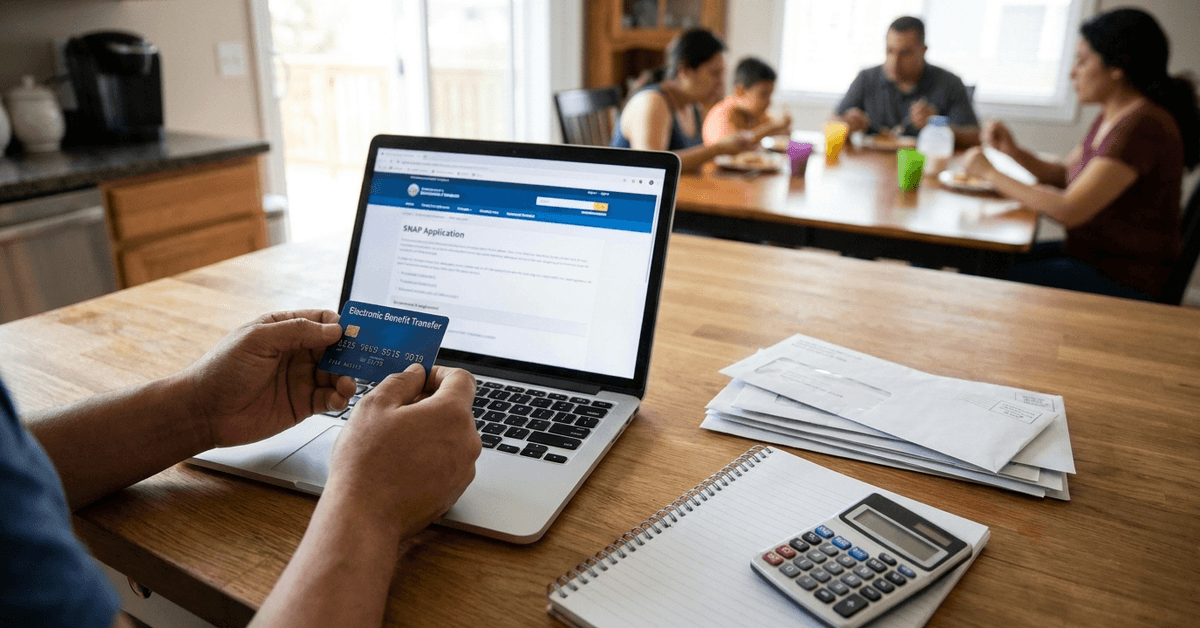
A SNAP application can count as filed with just your name, address and signature. If you need to apply for SNAP food stamps after losing a job, that date starts the clock.
Your state agency then has 30 days to decide, or 7 days if your household qualifies for expedited service. Pay stubs and leases can arrive later, after the filing date is locked in.
This guide is for the first-time applicant whose paycheck just stopped or shrank. If you have never set foot in a benefits office and want grocery money moving this month, keep reading.
How Do You Apply for SNAP Food Stamps in Your State?
SNAP applications go through your state agency, which accepts them online, by mail, or in person at a local office. The USDA funds the program, while each state runs its own portal, phone line and document checklist.
Those differences explain why two friends in different states can describe the process in completely different ways. The fastest way to find your state's intake page is USA.gov's food assistance directory.
Online, by Mail, or at the Office Counter
The online portal timestamps your filing the moment you hit submit, which makes it the quickest route where it exists. Paper forms still work, and the filing date becomes the day the office receives them.
Libraries and community centers sometimes help with forms, though their hours vary. Call ahead before you ride a bus across town for a help desk that closed at noon.
Should You File the SNAP Application Before Gathering Documents?
File the bare application first and gather documents second. Gather-everything-first is the standard order, and I'd flip it for one reason: under federal rules, the 30-day decision deadline runs from your filing date.
Federal SNAP rules require a state agency to decide a regular application within 30 days of the filing date. Why wait for a perfect folder when the calendar is already counting?
How the Filing Date Sets Your First SNAP Payment
Your first SNAP month is prorated from the day you apply, so it only covers the days left in that month. Filing on the 3rd instead of the 24th means a bigger first payment.
Missing proof triggers a verification request with its own due date, and Colorado's SNAP caseworker guide gives applicants 10 days plus one to respond. A late document can delay approval, while a late filing date permanently trims that first month.
Some states want more than the minimum before they schedule an interview. Read the instructions on your state's form so the short version still counts as complete enough to file.
Do You Qualify for Expedited SNAP in 7 Days?
Your household qualifies for expedited SNAP if it meets one of three federal criteria, and qualifying households get benefits within 7 days of applying. States screen every application for it automatically.
Fill in income and cash on hand even on a bare-bones form, since screening runs on those two numbers. Under federal SNAP rules, a household qualifies for expedited service if any of these apply:
- Gross monthly income under $150 and cash or savings of $100 or less
- Rent or mortgage plus utilities higher than monthly income plus cash on hand
- A destitute migrant or seasonal farmworker household with $100 or less in liquid resources
Regular vs. Expedited SNAP Processing
Colorado's June 2025 caseworker training says expedited cases postpone all verification except the applicant's identity. The two tracks compare like this:
| Step | Regular SNAP | Expedited SNAP |
|---|---|---|
| Decision deadline | 30 days from filing | 7 days from filing |
| Interview timing | Anytime within the 30 days | Within 7 days of filing |
| Proof needed up front | Full verification | Identity only; the rest postponed |
| Missed interview | Application can be rejected at day 30 | Expedited status lost; regular 30-day track continues |
I'd treat that interview as the most important appointment of the month, because NYC's Human Resources Administration drops the expedited track if it happens after day 7.
What Changed for SNAP Eligibility in 2026?
Work rules and non-citizen eligibility changed the most for 2026 applicants. Public Law 119-21, the One Big Beautiful Bill Act signed July 4, 2025, raised the SNAP work-requirement age range from 18 to 54 to 18 to 64.
Older guides, including plenty still ranking on Google, describe the pre-2025 rules. Anyone applying now should check two groups of changes.
SNAP Work Requirements for Adults 18 to 64
Able-bodied adults without dependents face these rules under Public Law 119-21:
- Work, volunteer or train at least 80 hours a month, or benefits stop after three months in a three-year period
- The parent exemption now covers only those with children under 14, down from under 18
- Exemptions for veterans, people experiencing homelessness and youth aging out of foster care were removed
I'd ask about qualifying hours during the interview itself, since county job-training programs that count toward the 80-hour rule differ from place to place.
Which Non-Citizens Can Still Get SNAP
The same law ended SNAP eligibility for refugees, asylees and trafficking victims, according to the Minnesota House Research summary of Public Law 119-21. States applied the cutoff on their own timelines.
Lawful permanent residents can still qualify under the existing waiting-period rules. A parent who no longer qualifies can still apply for an eligible U.S. citizen child in the household.
How Much SNAP Will You Get After October 1, 2026?
Your SNAP amount depends on household size, net income and deductions, up to a federal cap. USDA set the maximum monthly benefit at $306 for one person and $1,023 for a household of four for fiscal year 2027.
Those figures apply in the 48 contiguous states and D.C., while Alaska, Hawaii, Guam and the U.S. Virgin Islands have separate limits. USDA's SNAP eligibility page lists every household size.
| Figure (48 states + D.C.) | 1 person | 4 people |
|---|---|---|
| Max benefit, FY2026 | $298 | $994 |
| Max benefit, from Oct. 1, 2026 | $306 | $1,023 |
| Gross monthly income limit, FY2026 | $1,696 | $3,483 |
| Gross monthly income limit, from Oct. 1, 2026 | $1,729 | $3,575 |
The annual raise is about $29 a month for a family of four, so deductions can move your number further than inflation does.
SNAP Deductions That Raise Your Benefit
The excess shelter deduction now tops out at $789 a month, up from $744. Rent, utilities and dependent care you report lower the income SNAP counts against you.
I'd bring the electric bill even if it feels petty, because utility costs feed straight into that $789 shelter cap. Medical costs count too for household members who are elderly or disabled.
What Happens at the SNAP Interview (and After a Denial)?
The SNAP interview is a call or visit of about 30 minutes where a caseworker reviews your application with you, according to NYC's Human Resources Administration. It confirms details and fills gaps left on a short form.
Some agencies call from unfamiliar numbers, so answer the strange ones that week. Yes, even the ones that look like an extended car warranty pitch.
What to Do If Your SNAP Application Is Denied
A denial notice has to state the reason, and the usual causes are fixable:
- Missed interview: Colorado reopens the case on the original date if you request an interview within 30 days of denial with good cause
- Missing verification: send the requested proof and ask whether the case can be reopened instead of restarted
- Income over the limit: check whether rent, childcare or medical costs were left out
Every state also offers a fair hearing if you think the decision is wrong. The deadline to request one appears on the denial notice itself.
Questions People Ask About Applying for SNAP
These come up most often once the application is in and the waiting starts.
- Q: Can I buy soda or candy with SNAP in 2026?
It depends on your state. Nearly 20 states have banned or plan to ban sugary drinks and sweets from SNAP purchases, so check your state agency's eligible-items list before checkout. - Q: Does SNAP count as taxable income?
No. SNAP benefits are not taxable and do not affect federal taxes, though keeping your approval letters helps if another program asks for proof later. - Q: Will my landlord or employer find out I applied for SNAP?
Federal rules keep your application confidential, and agencies do not share it with landlords or employers. The caseworker may still contact an employer to verify income you listed, which is part of checking your paperwork. - Q: How long does the EBT card take to arrive?
NYC's Human Resources Administration mails cards within five business days of approval. Other states run on similar timelines, so call your agency if a week passes with nothing in the mailbox. - Q: Do all grocery stores accept EBT?
Most major supermarkets and many neighborhood stores do, and some states allow EBT for online grocery orders. Smaller shops may not be authorized, so ask at the register before loading the cart.
Conclusion
File the short SNAP form today, because the filing date sets your first month and every deadline after it. Check whether expedited service fits your household, since a 7-day interview window can put groceries on the table faster.
Adults between 18 and 64 should ask early which training or volunteer hours count toward the monthly 80. So what is sitting on your kitchen counter right now that could count as proof of a deduction?