Getting approved by a delivery app is the easy part of food delivery jobs in Europe. The harder step: France expects couriers to register as self-employed before they ride.
The rules are moving. EU member states must write the Platform Work Directive into national law by December 2, 2026, and it presumes couriers are employees when an app directs and controls their work.
This guide is for one reader: the expat or international student who just arrived and wants a first courier gig without signing the wrong kind of contract.
Can Newcomers Get Food Delivery Jobs in Europe Right Now?
Yes, if you are 18 or older, hold the right to work, and have a smartphone plus a bike, scooter or car. Every major app runs its courier sign-up online.
A food delivery job in Europe requires a minimum age of 18, a valid right to work locally, a compatible smartphone and an approved vehicle.
The Visa Check Is Where Newcomers Stall
EU residents get the smoothest approval. Non-EU newcomers need a residence permit that allows work, and some student permits limit weekly hours, so read the permit wording first.
Borrowing someone else's courier account looks like a shortcut. Spain's labour ministry fined Glovo in 2022 and 2023, partly for handing gigs to people without valid work permits.
Why Your Country Matters More Than Your Delivery App
The same app can give you two very different jobs depending on the border. Spain's 2021 Riders' Law presumes that couriers delivering through digital platforms are employees.
I'd choose the country first and the app second, because a UK courier files one simple self-assessment while a French courier must register as self-employed and pay quarterly contributions.
Spain Already Put Glovo Riders on Payroll
Glovo cut off its remaining freelance riders in Spain on July 1, 2025. Couriers who stayed signed salaried contracts of 15 to 25 hours a week at minimum hourly wage.
Salaried Glovo riders in Spain work only for Glovo, while couriers hired through subcontracted fleets can still ride for other apps.
December 2, 2026 Flips the Burden of Proof
Under the directive, a platform that directs and controls the work must prove the courier is self-employed. The full text of Directive (EU) 2024/2831 is public.
As of May 2026, only Italy had a draft decree in parliament and Spain had just opened a consultation. The European Commission says the deadline will not move.
So what happens to a freelance contract signed in November? I'd read any agreement signed this autumn with December 2, 2026 in mind and look for a review clause.
Glovo, Deliveroo, Uber Eats or Just Eat: Who Operates Where?
Four big apps handle the bulk of courier work across Europe, and each leans on a different set of countries. Deliveroo runs in the UK, Ireland, Belgium, France and Italy, and DoorDash completed its takeover of the company on October 2, 2025.
| Platform | Main European markets | Vehicle and contract notes |
|---|---|---|
| Glovo | Spain, Italy, Portugal, Poland, Eastern Europe | Spanish riders salaried since mid-2025 |
| Deliveroo | UK, Ireland, Belgium, France, Italy | Over 18, right to work, phone and vehicle |
| Uber Eats | 15+ European countries | Licence and insurance for scooter or car couriers |
| Just Eat (Takeaway.com) | Germany, Netherlands, Nordics | Mix of part-time and freelance contracts |
I'd look at Just Eat first in Germany or the Netherlands if you want part-time hours instead of pure gig terms.
Check Who Owns the App Before You Sign
Prosus agreed in 2025 to buy Just Eat Takeaway.com for €4.1 billion, and DoorDash already owned Wolt before adding Deliveroo.
Ownership changes can bring new rider terms. Download the current agreement during sign-up instead of trusting a courier review from 2024.
What Documents Do Delivery Apps Ask For in 2026?
Courier sign-up on European delivery apps asks for an ID upload, proof of your right to work and a vehicle declaration, plus a licence and insurance for mopeds or cars.
I'd scan all five documents below before opening any app, so the upload takes minutes:
- Passport or national ID
- Residence permit or work authorisation if you hold a non-EU passport
- Proof of address or student status, which some platforms request
- A recent background check, asked for by some apps
- Driving licence and insurance for moped or car couriers
Bike Riders Skip a Whole Step
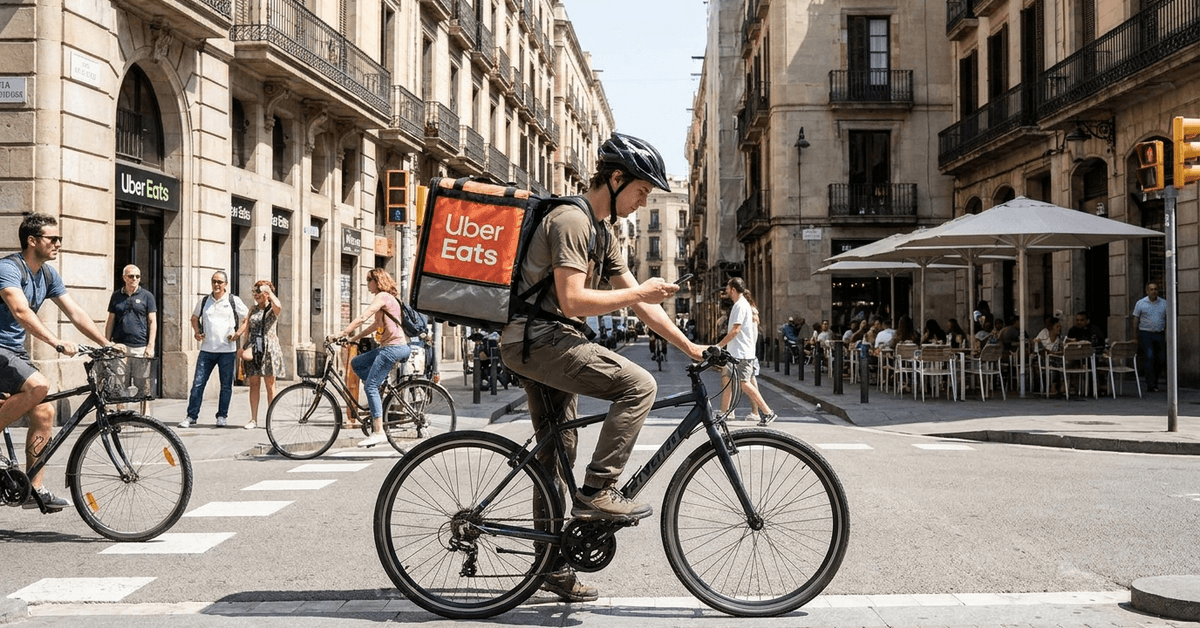
I'd start on a bicycle in any city that allows it, since bicyclists skip the licence and insurance uploads in most regions. Your legs do the work, and the paperwork shrinks to two files.
Moped and car couriers face extra checks, and some cities add their own licensing rules on top.
Deliveroo says it gives free insurance to all its riders. Check the cover on the Deliveroo rider site before paying for a separate policy.
What Happens After You Hit Submit
Approval usually follows a short, predictable sequence:
- Create a courier profile and upload your documents
- Wait for email confirmation, usually within days
- Declare your vehicle type
- Finish short online modules on safety, customer service and routing
- Set availability that covers lunch and dinner peaks
Face-to-face training is rare, though a few cities still run it. Peak availability may speed onboarding in crowded cities, but approval is never guaranteed.
Freelance or Salaried: Which Courier Contract Should You Want?
A salaried contract is the safer first deal for a newcomer, even though freelance terms get sold as the flexible choice.
A self-employed courier pays their own tax and social contributions, while a salaried courier has them deducted through payroll. Glovo itself still argues freelancing gives riders more flexibility.
I'd take payroll anyway, because France and Italy make freelance couriers declare income and pay contributions every quarter, and accident cover varies by platform. A capped week beats a surprise tax bill.
Taxes Freelance Couriers Owe, Country by Country
If you do go freelance, set up these habits from week one:
- France and Italy: declare income and pay quarterly contributions as a self-employed worker
- UK: file a simple annual self-assessment
- Every country: track gross income and set aside a share for tax each week
- Year end: use the platform's annual summary to check your totals
The common mistake is spending the full weekly payout, then meeting the tax bill with nothing saved.
Which European Cities Have the Most Delivery Work?
London, Paris, Berlin, Barcelona and Milan have the steadiest courier demand, often with several apps competing on the same streets. Peak hours get crowded, but demand usually evens out across the week.
Tourist Hubs Run Hot and Cold
Amsterdam, Lisbon, Prague and Vienna have lively markets full of students and travellers earning extra income. Shifts there rise and fall with tourist season.
Arriving in Lisbon in January? Expect thinner order volume than the summer crowd saw, and watch for peak-time bonuses that can lift earnings above the local hourly minimum.
Questions People Ask About Food Delivery Jobs in Europe
A few questions come up again and again from people about to send their first courier application.
- Q: Can I work for two delivery apps at the same time in Europe?
Often yes, since big cities run several apps side by side. Salaried Glovo riders in Spain are the exception, because staff contracts tie them to Glovo only. - Q: How long does it take to get approved as a food delivery courier?
Email confirmation usually arrives within days of uploading your documents. A background check or a missing permit drags it out, so upload clean scans the first time. - Q: Will the EU directive turn me into an employee automatically in December 2026?
Not automatically. The presumption applies when the app directs and controls your work, and the platform can still try to prove you are self-employed. Each country's own law will set the details. - Q: Do delivery apps pay sign-up bonuses for new couriers?
Some offer starter incentives and peak-time bonuses, though none are guaranteed and amounts change by city. Treat a bonus as a nice extra, never as the reason to pick a platform. - Q: Do I need a car to deliver food in Europe?
No. Bicycles are accepted on most apps and skip the licence and insurance uploads entirely, while cars and mopeds add range along with extra paperwork.
Conclusion
Food delivery jobs in Europe still open quickly to newcomers who have a phone, a bike and permission to work. The contract behind the app is what changes between Madrid, Paris and London, so read it first.
December 2, 2026 will reshape those contracts again as each country writes the EU directive into its own law. So pick your country carefully, then check exactly which kind of rider each app would make you.